





Picture yourself standing beneath a dark Andalusian sky, encircled by latticed stone that shimmers in the moonlight, and knowing that over 200,000 other people experience the same goosebumps every year. That is the quiet power of the Alhambra Palace night tour, and it is that power — translated into tickets, timed entries, and carefully managed footfall — that has made Alhambra Palace night tour attendance revenue one of the most closely watched figures in European cultural heritage management. Every magical hour after sunset, from the golden Nasrid Palaces to the Generalife gardens’ whispering fountains, is more than simply an experience; it’s a meticulously constructed economic engine.
Why Alhambra Palace Night Tour Attendance Revenue Matters Beyond the Ticket Booth
It is important to understand the product being marketed before discussing the figures. Nighttime tours of the Alhambra are not like rides at a theme park. There are few sites on Earth that can compare to the two hours spent immersed in a Moorish world of the fourteenth century in terms of the dramatic atmosphere it provides. Patronato de la Alhambra y Generalife, the Spanish government agency in charge of the site’s administration, and the Spanish government itself have long recognized the inherent rarity of the commodity. The premium experience and minimal crowds are maintained by strict capacity limitations. So, be prepared to wait weeks—if not months—for your night ticket, and be prepared to pay multiples of the official price on resale marketplaces.
The revenue narrative is driven by this delicate balancing act between accessibility and exclusivity. How the institution has monetized wonder without devaluing it is more important than the number of visitors.
Breaking Down the Attendance Numbers: How Many People Actually Visit After Dark?
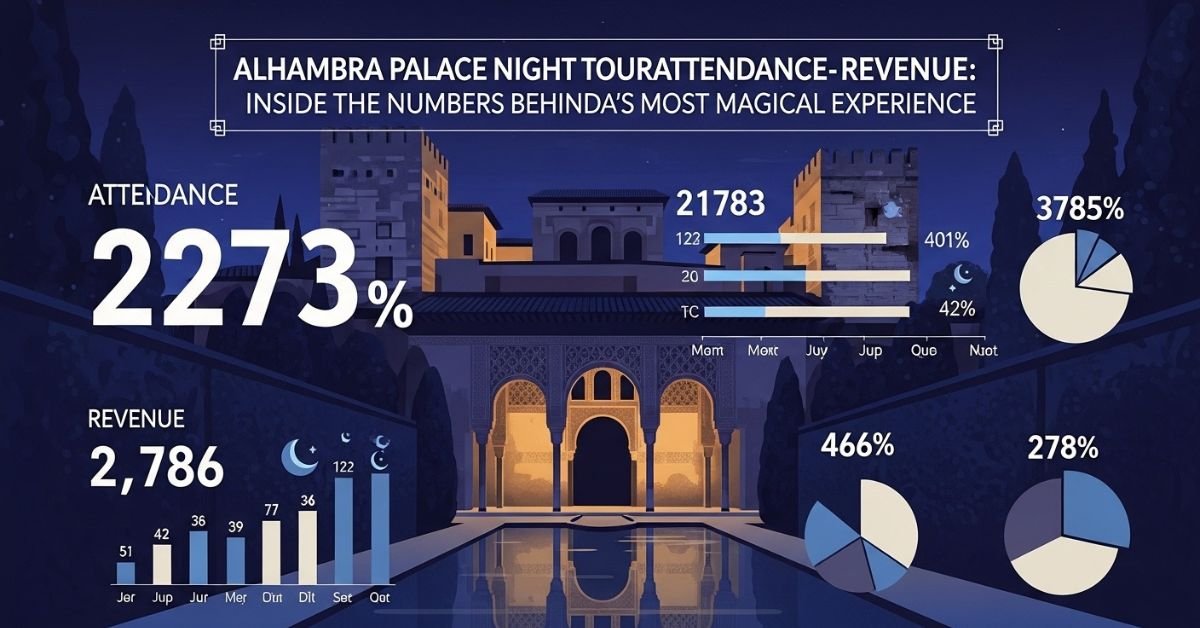
At over 2.5 million per year, the Alhambra is undeniably one of Europe’s most popular tourist attractions. Night visits, on the other hand, follow a distinct and severely limited timetable. In the spring and summer, the Nasrid Palaces are open for evening sessions from Tuesday through Saturday. A strictly limited number of people are admitted each session, with an average of about 400 visitors per session in previous years.
In a full year of operation, that amounts to around 150,000 to 200,000 committed nighttime patrons. These folks did not just happen to be strolling by on a sunny day. These vacationers are true adventurers; they spent all day and night preparing for just one event. That type of audience—motivated, well-off, and culturally curious—is ideal for Granada’s economy because of the robust spending it produces downstream.
Seasonal Patterns and Their Impact on Revenue Flow
Between April and October, when the days are longer and warmer, the nighttime experience is at its most popular, and attendance is at an all-time high. Session numbers are lower in December and January for a variety of reasons, including operational limitations and a general decline in visitor traffic to Granada. Because of this seasonality, the Patronato has mastered the art of controlling their revenue curve, which allows them to support their conservation efforts all year round by front-loading their income during peak months.
The Pricing Structure Driving Alhambra Palace Night Tour Attendance Revenue
The official night visit tickets for the Nasrid Palaces cost roughly €14 for people, which is rather affordable compared to other international heritage sites. The per-person cost increases significantly with guided extras, combo packages that incorporate the Generalife gardens, and premium group activities. Revenue from the night program alone might reach close to €2.5 million when the standard ticket price is multiplied by the 180,000 yearly visits.
Although striking when considered alone, the number masks the true economic reality. Consistent with previous research on heritage tourism, travelers spend four to seven euros in the surrounding destination for every euro spent at the monument itself. The city of Granada experiences a gravitational pull from the night tours of the Alhambra Palace, which benefits hotels, tapas cafés, flamenco performances, and local artisan businesses.
Conservation Funding: Where the Night Tour Revenue Actually Goes
The use of these funds is one of the less interesting but really crucial parts of this income narrative. No matter the time of day, a large chunk of the Patronato de la Alhambra’s ticket sales goes back toward preservation, repair, and study. With its ancient water systems, delicate plasterwork of the Nasrid Palaces, and gardens that require continual horticultural care, the palace complex presents an unparalleled challenge to upkeep.
Interestingly, compared to visits during the day, nighttime ones cause less wear and tear. Stonework is less stressed by the colder weather, and there are less vibrations and less dampness due to body heat and breath in smaller groups. The night program is more than simply a means to an end—it’s also a kinder introduction to the monument to the outside world.
The Human Side: What Attendance Figures Cannot Fully Capture
While numerical data is helpful, it is incomplete. Something that no spreadsheet can record is the impact on people: the experience alters them. Just ask anybody who has strolled beneath a full moon in the Court of the Lions or listened to the fountains of the Generalife in near-total quiet. When the sun goes down, the Alhambra becomes a hauntingly quiet place that the daily visitors just can’t get to.
Tour guides often talk about how their clients have been planning the trip for years, whether it’s a long-awaited retirement trip, an anniversary celebration, or a parent’s desire for their children to see a world that is bigger, older, and more beautiful than what they can see on TV. That sentimental value is what keeps demand going year after year, rain or shine, regardless of the state of the economy.
The Future of Alhambra Palace Night Tour Attendance Revenue: Challenges and Opportunities
In the future, the Patronato will have to deal with a very challenging conflict. There is a compelling need for increasing capacity due to the persistent demand for night visits surpassing availability. However, as any legacy management worth their salt can tell you, the experience is as valuable as its scarcity, and the latter determines the former’s long-term profitability. If the Nasrid Palaces are as crowded at night as they are during the day, the mystique will disappear along with the premium prices that the existing model allows.
Raising the offer’s depth, rather than the gate’s width, is the more fruitful strategy. Intimate sessions centered on certain palaces, evenings dedicated to architectural history, and nights of music and poetry steeped in Andalusian heritage are all examples of specialist topic tours that might enable small revenue increase without sacrificing the premium-worthy intimacy. With proper integration, digital storytelling technologies may lengthen the experience without watering it down.
Final Thoughts: Alhambra Palace night tour attendance revenue
Alhambra Palace night tour attendance revenue is, at its core, a story about what happens when genuine beauty is managed with genuine care. The Patronato’s successful night program is not a fluke; rather, it is the result of decades of concerted effort to manage capacity, implement smart pricing, and maintain the experience that draws customers.
This is a numbers game. The direct ticket income of almost €2.5 million is significant. The local economy of Granada is affected by the multiplier effect. At least as important as the exact number of attendees is the fact that each one of them stood in the pitch black, gazed up at the starry palace that has weathered the test of time, and experienced an emotion they will never forget. This is an excellent example of heritage management in action, and it serves as a timely reminder of why the preservation of cultural treasures like the Alhambra is so important.