





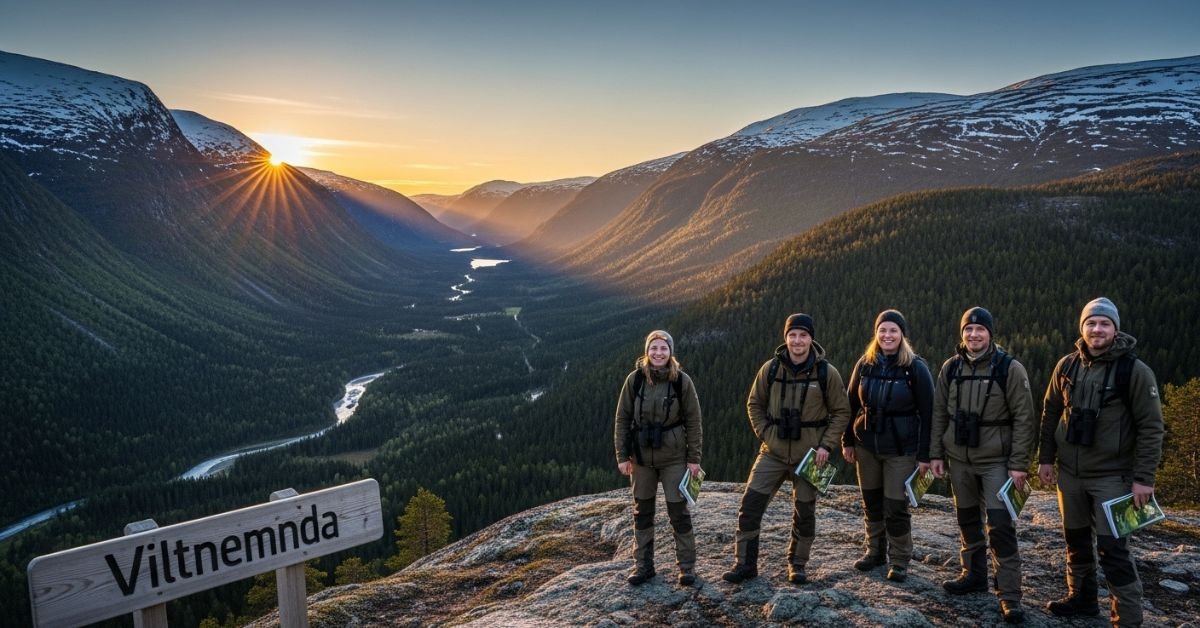
Decisions made by a group of regular individuals in a tiny Norwegian municipality will have long-term effects on fields, woods, and fjord margins; these people include farmers, foresters, local councillors, and environment enthusiasts. They are not well-known figures. They fail to garner widespread media attention. However, their decisions about animal population control, wildlife corridors, and hunting limits affect the scenery that their neighbours see first thing in the morning. The viltnemnda are these low-lying creatures who operate slowly and softly; if you’re unfamiliar with them, that’s the purpose.
What Is Viltnemnda?
The Norwegian word “viltnemnda” means something like “wildlife committee” or “game management board.” These are municipal-level, locally-appointed organizations in Norway that are responsible for wildlife management within their respective areas. While all municipalities adhere to the same national framework established by the Wildlife Act and the Norwegian Environment Agency, the day-to-day choices made by each municipality are distinctly local. This is because each municipality has its own viltnemnda.
In most cases, the local council will nominate members to a viltnemnda, and their terms will often coincide with the election cycle. They are not some Oslo-based bureaucrats. They are the ones who reside in the areas where wildlife such as elk and beavers make their homes and where, on cold winter evenings, deer walk into gardens. That closeness to the ground is crucial; in fact, it is the entire objective.
The Core Responsibilities of Viltnemnda
Someone not familiar with Norwegian government would assume that a viltnemnda meets sometimes to discuss fox sightings or deals with paperwork and licenses. The truth is far more complex. When it comes to managing Norway’s wild animal populations, these committees are really powerful administratively.
Hunting Regulation and Quota Management
Supervising hunting inside the municipality is one of the main roles of viltnemnda. This includes handling applications, establishing local quotas for animals like deer and elk, and making sure that hunting doesn’t exceed the limitations imposed by various levels of government. Finding that sweet spot is trickier than it seems. Crop failure, vehicular accidents, and environmental stress on plants are all possible outcomes of killed animals that are undersized. When too many people go hunting, populations might go so low that they take a long time to recover.
Wildlife Monitoring and Population Data
Viltnemnda is also involved in the process of collecting and reporting information about the populations of local animals. Members work along with landowners and hunters to keep tabs on population sizes, observe any suspicious behavior, and report any concerns regarding diseases or environmental changes. Local committees play an essential role in Norway’s wildlife monitoring system since they provide intelligence from the grassroots up, which is then incorporated into the larger national picture.
Also Read Schwarnitz: History, Nature & Adventure Guide
Why Viltnemnda Matters Beyond the Numbers
Counting the number of elk, permits, and reports submitted would be a simple way to simplify viltnemnda. However, that perspective fails to take into account a crucial aspect of the committees’ true purpose. Viltnemnda is a site where the practical, human aspects of the interaction between humans and environment are negotiated, in a country where this relationship is woven into national identity.
Now picture this: an elk population boom is ruining harvests for farmers in Innlandet county. For example, a family in Troms may have had their hiking paths ruined by local predators. Real people are under actual stress because of these issues, not some theoretical policy dilemma. Those individuals take their complaints to Viltnemnda. Here, the distance between decision-makers and impacted citizens is measured in kilometers, not continents; it is the pinnacle of local governance.
The Human Side of Viltnemnda Membership
There is little glamour about serving on a viltnemnda. Not only is there little national attention, but there is also no substantial compensation and an abundance of opposing viewpoints to negotiate. Members frequently discover themselves in the midst of conflicting demands from several groups, including hunters for greater access, environmentalists for greater protection, and landowners for increased recompense.
Still, individuals continue to turn up. They take part in the gatherings, study the demographic data, survey the area, and ultimately make the decisions. You should be recognized for your unassuming dedication, which entails performing the mundane tasks since they are important to the location you reside. Without these local volunteers, Norway’s wildlife management system would not work nearly as successfully.
Viltnemnda in the Context of Norwegian Wildlife Law
A quick review of the legal framework around viltnemnda is necessary for a correct understanding of it. Viltloven, Norway’s Wildlife Act, lays forth the rules for the country’s management, protection, and harvesting of wildlife. There is a division of labor between the federal, state, and local levels within that structure. The local implementation layer, which Viltnemnda occupies, is located at the bottom of the structure.
Viltnemnda is not free to do as it pleases because to this multi-tiered arrangement. National conservation goals and county-level strategies must be considered when making decisions. However, true local discretion exists within those parameters, and it is severely exercised. The concept is based on the assumption that locals have the greatest perspective on the area.
What Viltnemnda Can Teach Us About Local Governance
The lesson here isn’t only about hunting permits and elk limits. A system that really devolves decision-making authority to the local level and trusts the people there to utilize it properly is becoming more unusual in modern government, yet Viltnemnda exemplifies this. No committee system is without flaws, but this one shows how seriously we take the idea that real, rather than theoretical, understanding of a location is used when planning environmental protection efforts.
When it comes to managing animal conflict, rural community needs, and biodiversity all at once, the Norwegian approach (and viltnemnda in particular) provides a paradigm that other nations should learn from.
Closing Thoughts on Viltnemnda
The next time you stroll through a Norwegian forest and observe how it exudes a sense of equilibrium—not completely devoid of life, but vibrant and full of life—it’s likely that a viltnemnda played a role. Not via sudden, spectacular action, but rather the slow, unglamorous, very human labor of individuals who love their home and are prepared to talk about it till they find a solution that works for everyone.
That is the ultimate meaning of viltnemnda. Not red tape. Nothing to do with paperwork. Nothing more than humans, some land, and the never-ending quest to find a way to divide them up.
Also Read Primacoast.com: Coastal Adventures, Travel Tips & Gems